
Point Court Docket Searches
The city's own pages offer no search by name, case number, or citation number, and no way to pay online. Everything runs through the municipal court clerk, Tasha Wilk. Before calling or writing, have the citation number, its date, the issuing officer or agency, the name on the ticket, and the expected court date in hand.
- Confirm Point Municipal Court is printed on the citation.
- Collect all citation and setting details.
- Open the official Point court page.
- Ask the clerk for status, date, and the current hearing location.
- Ask about fees and delivery before requesting a copy.
Finding nothing in a county search does not mean Point holds no record. Municipal files stay with the city unless the clerk identifies another custodian.
Point Clerk-First Record Access
Tasha Wilk, the municipal court clerk, takes calls at 903-598-3296 extension 3 and email at courtclerk@cityofpoint.org. The city also lists Judge Bounds. The court page posts no full hours, no terminal policy, and no courtroom address.
Point Municipal Court
Judge Bounds
Clerk: Tasha Wilk
903-598-3296 ext. 3
Email: courtclerk@cityofpoint.org
City contact: 320 N. Locust Street, Point, TX 75472
The Locust Street address belongs to City Hall, not a confirmed courtroom. So ask where the hearing will be held. Ask, too, whether email works for a specific plea, copy, or certified-record request.
Inside the Point Municipal Court
Point Municipal Court is a city court. It is distinct from the Rains County Justice of the Peace, the constitutional County Court, and the District Courts. A municipal citation stays a Point record. That holds unless the clerk points to an appeal, a transfer, or a different issuing court.
The city's official page gives contacts and a schedule update but no public lookup tool. That gap shapes the workflow. Call or email the clerk rather than hunting through unrelated county PDFs. State exactly what you need, whether a setting, a docket entry, a plain copy, or a certified disposition.
Read entries with care. A charge description is an allegation, not proof of guilt. A schedule entry is not a judgment. For an outcome, the underlying order or certified disposition is the better source.
Point Schedule Changed in 2026
The official city notice sets the new schedule: municipal court convenes at 10:00 a.m. on the second Wednesday of each month beginning February 11, 2026. The notice itself was posted December 22, 2025. Any date you rely on should carry that effective date with it.
Confirm before travel: a dated Point schedule notice can be superseded, and the city has not confirmed City Hall as every hearing’s courtroom.
A monthly pattern never overrides a citation, a reset, a cancellation, a continuance, or a later order. When dates conflict, call the clerk.
Finding Point Court Dates
Read the citation and the current city notice together, since the Point docket takes more than a day of the month. Confirm the court, the time, the place, the judge, and the purpose of the setting.
| Date | Second Wednesday monthly under the 2026 notice, subject to the case record. |
|---|---|
| Time | 10:00 a.m. under the dated notice. |
| Location | Not stated on the court page; confirm with the clerk. |
| Judge | Judge Bounds is listed by Point. |
| Setting type | The citation, order, or clerk identifies the purpose. |
Save the confirmation. An old image or a generic monthly notice carries less weight than the latest direct instruction from the Point court.
Point Requests Need Useful Detail
A precise request makes the clerk-first route work. Give the citation number and its date. Include the issuing officer or agency, the court date, and the name printed on the citation. Ask for the specific document, not every record tied to a person.
Need a certified copy? Say so up front, and ask about cost, accepted payment, delivery method, and turnaround. No Point source fixes a fee or promises email delivery. The clerk supplies those terms.
For a setting, ask whether the case is still active. Ask whether the regular monthly time applies, and where to appear. That avoids treating City Hall as a courtroom on assumption.
Point Traffic Ticket Lookups
Point has no public citation database. It has no online payment route either. A Point ticket lookup therefore starts with the clerk, not a payment vendor. A missing web result never means the ticket was cleared or transferred.
Hand the clerk the citation reference and the issuing authority. The ticket may name the county Justice of the Peace or Texas Highway Patrol. Follow that court instead if so. The broader routing distinctions appear under Rains County traffic court records.
Ask what plea or response is on file and whether a date remains active. Paying, contesting, requesting more time, and asking for a copy are different acts. Point's published pages give no basis for assuming any of them can be done online.
Point Court Activity Needs Labels
The OCA 2024–25 municipal report counts 2,931 criminal matters active pending for Point on September 1, 2024. During the year it tallies 61 reactivated, 1,817 added, 1,567 disposed, and 292 placed inactive. By August 31, 2025, active pending stood at 2,950.
These are docket-accounting totals, not unique people or convictions. OCA's population column reads 817 while the city's 2020 Census count is 745. Compare the pending inventory to population only with those source and time labels attached.
How Point Cases Reach the County
Point municipal matters stay at the city level. Class A and B misdemeanors handled by the county generally sit with the County Clerk, while District felonies and broad civil cases belong to the District Clerk. The Justice of the Peace keeps its own limited docket.
Docket flow: Point Municipal Court › Rains County Courts › District Courts of Rains County
These are court levels, not a guaranteed route that every Point case follows. If the Point clerk says a matter was appealed or moved to a new court, get the exact court name and cause number before you search again.
Point Official Sources Show the Gap
The Point Municipal Court page is the source for clerk and judge details.
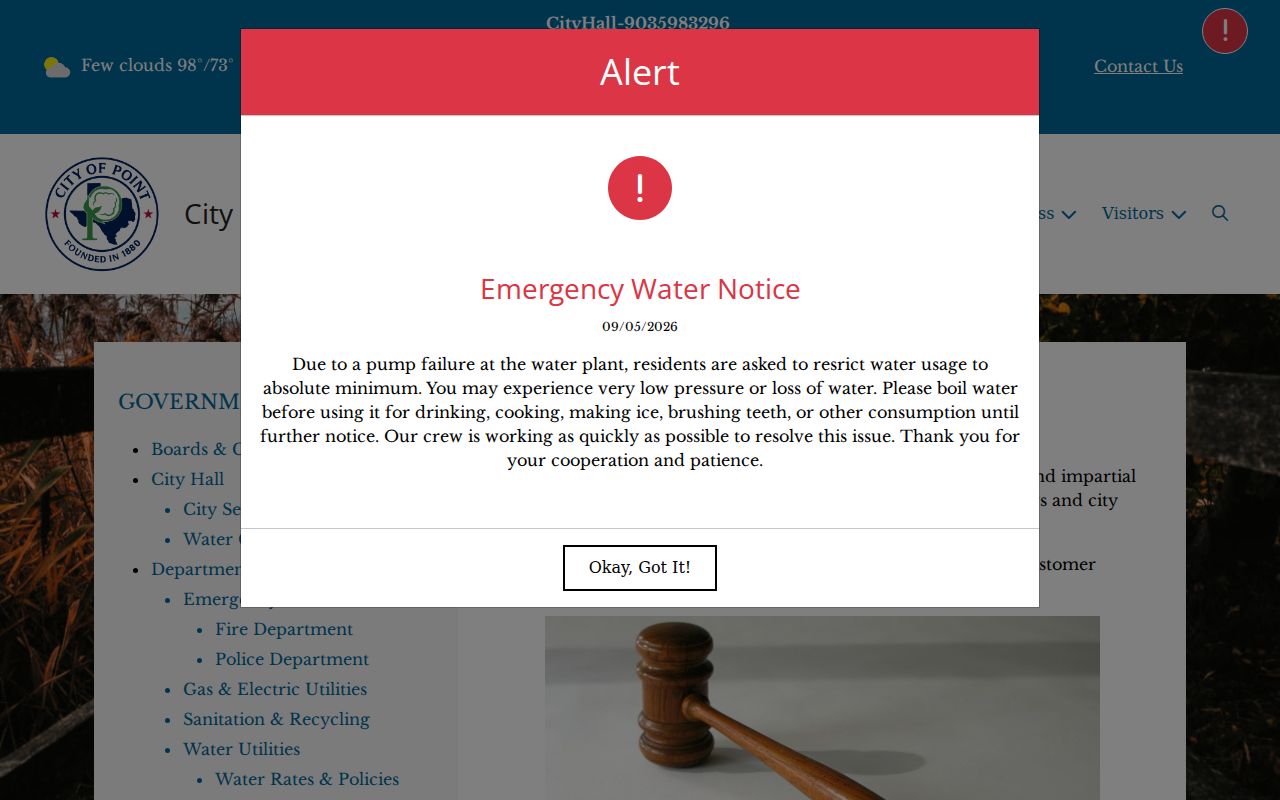
The official Point city page gives a direct way to reach City Hall, and it carries the February 2026 time-change notice as well. Nothing on it invents a search portal or a courtroom address that the city never published.
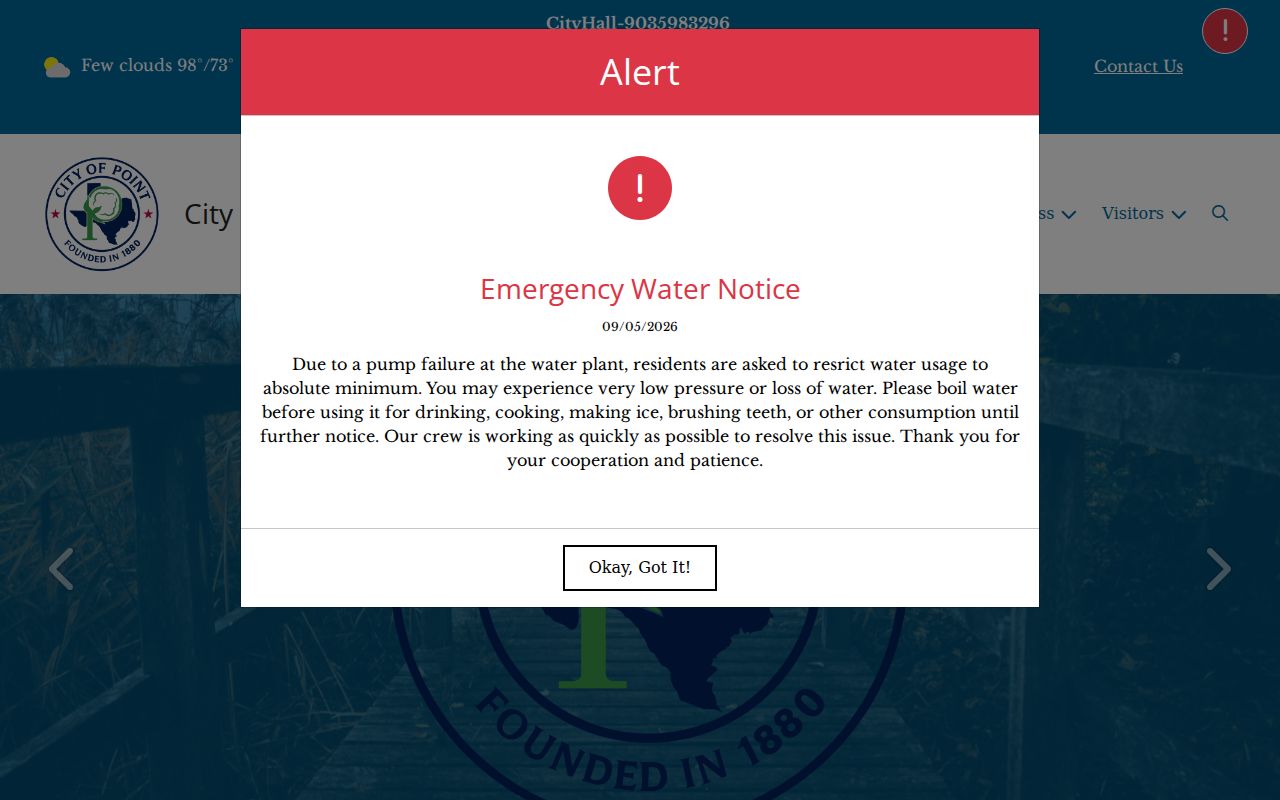
Because the notice carries a date, confirm the schedule yourself. It does not prove every hearing happens at City Hall.
Point Statistics Source Context
The Texas courts statistical index identifies the official reporting cycle behind Point’s aggregate figures.
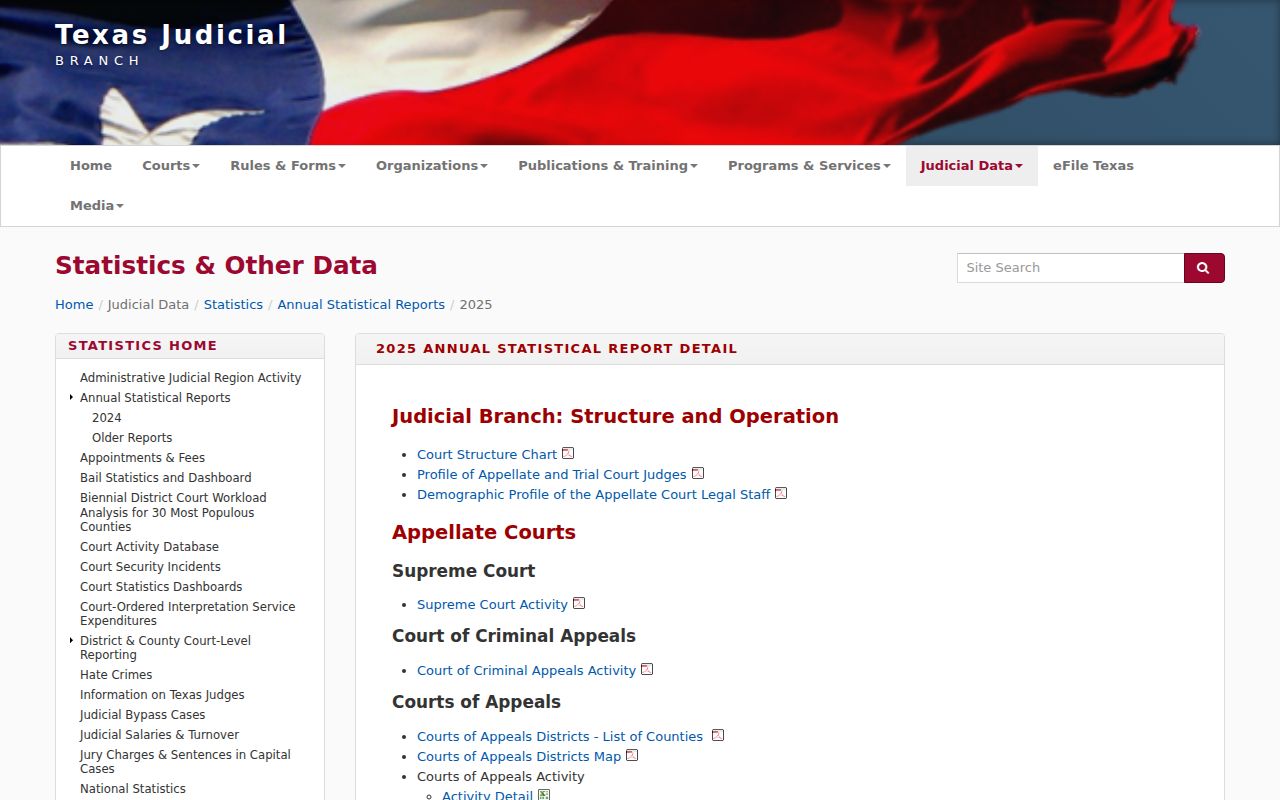
Use this source for workload context only. It cannot find a Point citation. It cannot explain the large pending inventory. It cannot settle any single case's outcome.
The report lists zero in Point's extracted civil and administrative columns. That zero describes the reporting row, not the court's true reach. It does not mean Point can never hear a matter outside the summarized criminal grouping. For an actual file, rely on current court jurisdiction and clerk guidance.
Who Can See Point Court Records
The public may request Point court records from the municipal clerk. Some limits still apply. Juvenile, sealed, expunged, nondisclosed, and sensitive information can be withheld. A blank result does not prove no file exists.
Key rules:
Texas court-record policy distinguishes adjudicative case files from ordinary agency requests.
Texas Government Code chapter 552 governs many public records but does not replace court-file rules.
Texas Family Code chapter 58 addresses juvenile confidentiality.
Ask Tasha Wilk whether a limit comes from law, rule, order, or incomplete indexing. Certification must come from the office holding the record.
Point Location and Status Checks
Point demands two confirmations that are easy to miss. First, confirm the hearing place. The court page gives no courtroom address. Second, confirm current status, since the published schedule is a dated general notice rather than a live case calendar. Give Tasha Wilk the full citation reference. Ask whether an appearance, plea, payment, or other response is now due. Write down the date of the reply and how it arrived.
Keep each kind of proof in its proper role. A city notice shows what Point published about the regular schedule. A clerk message can confirm a current setting. A receipt documents a transaction. A signed order or certified final record establishes the court's action, and none of these substitutes for another. That chain matters because Point has no portal. City Hall is a verified contact address but not a confirmed hearing site.
A request may turn up no match. If so, recheck the spelling, citation number, issuing agency, and the court named on the paper. Do not assume the matter moved to Rains County. Ask the Point clerk whether a new court or cause number exists. When you request a copy, say whether you want plain or certified form. Ask about price and delivery too. Point publishes no fixed fee, payment method, or response time.
Point Clerk Requests by Purpose
A Point request works best when it names one purpose. For a date check, give the citation number. Ask for the next setting, time, and confirmed place. For a status check, ask what plea, response, or order is currently entered. For a copy, identify the exact document and say whether certification is needed. This spares the clerk from guessing what "the whole record" means. It also keeps you from asking the county clerk for a municipal file that Point still holds.
Phone and email are documented. The city source does not promise that either channel completes every court act. Ask whether an original signature, personal appearance, mailed paper, or approved payment method is required. If the clerk points you to another court, write down that court's full name and cause number. Treat the referral only as what the clerk states. It is not proof of an appeal or transfer. A careful Point docket search follows the verified office. It keeps the current schedule notice, and ends with the document that answers your actual question.