
Emory Court Docket Searches
The city's municipal page offers no public search by name, case number, or citation number. That makes the clerk the dependable route into any Emory court docket. Read the court name on your citation first. If Emory Municipal Court appears, gather your key details. Write down the citation number and issue date. Add the listed name, alleged violation, and court date. Those details separate a city file from a Justice of the Peace matter.
- Confirm Emory Municipal Court is named on the citation.
- Gather the citation number, date, listed name, and court date.
- Open the official Emory court page.
- Ask the clerk for the setting, status, or copy needed.
- Confirm the date and response requirement directly.
Nothing online does not mean no case exists. A payment link is not a case-history database, and a blank screen proves nothing either way. When the citation names a different issuing court, take your search there instead.
Emory Clerk Contact Route
Elizabeth Davis serves as the clerk Emory lists. Reach the court at 903-473-2465 extension 103, or email elizabeth@emorytx.com. Walk-in business happens at Emory City Hall, 399 N. Texas Street, Emory, Texas 75472. Mail takes a different path: P.O. Box 100, Emory, Texas 75440. Keeping those two straight matters when an original paper or a deadline is in play.
Emory Municipal Court
Clerk: Elizabeth Davis
399 N. Texas Street, Emory, TX 75472
Mail: P.O. Box 100, Emory, TX 75440
903-473-2465 ext. 103
Email: elizabeth@emorytx.com
Ask before emailing any record request. Email copies are not guaranteed. Name the exact item you need, and say whether a plain or certified copy is required.
Inside the Emory Municipal Court
Emory Municipal Court handles city ordinance violations, traffic matters, and certain Class C Penal Code cases. Those are city records. Emory is the county seat. That role does not turn them into County Court, District Court, or Justice of the Peace files. The issuing court named on the paper decides where the case lives. The clock runs ten days from the citation. City rules give a cited person that time to appear or contact the court. Do not guess based on another court's practice. Contact the court. Learn what plea or form it accepts and when your matter is set. Special appearance rules apply to minors under seventeen. They also cover people under twenty-one in alcohol-related matters. The court checks this before it accepts a fine. Follow the city's current instructions rather than assuming online payment settles an appearance.
Emory Citation Response Window
The ten-day window stands out as one of the clearest rules in Emory court records. It is a deadline to appear or contact the court. It is not a promise of a trial within ten days. Your response lets the court enter a plea or request into the municipal record. It also sets the next event. Do not sit back and wait for a public database. The court posts none. If the deadline is close, use the clerk phone or contact details. Keep a copy of whatever you send. Note when you made contact. Mailing a form? Confirm the address and ask whether the clerk counts receipt, not postmark.
Timing matters: Emory says to appear or contact the municipal court no later than ten days after the citation. Confirm the requirement with the clerk.
Finding Emory Court Dates
Your date may show up on the citation. It may come in a later notice instead. The city publishes no public calendar or searchable docket. Verify the date, time, place, judge, and setting type with the clerk. A routine schedule never substitutes for the setting on your specific case.
| Date | The day shown on the citation, notice, or clerk-confirmed record. |
|---|---|
| Time | The start time for the listed setting. |
| Location | Emory City Hall is the verified court address. |
| Case reference | The citation or case number used by the clerk. |
| Setting type | Plea, formal trial, compliance matter, or other event. |
Ask again when a notice conflicts with what the clerk tells you. A reset, cancellation, or later order can shift the Emory docket.
Emory Pleas Shape Records
The city page lays out guilty, no-contest, and not-guilty pleas. Not guilty sends the case to formal trial. Each plea creates a different procedural entry, so treat payment as an act with legal weight, not a neutral search step.
| Plea | Record path | Next check |
|---|---|---|
| Guilty | Response enters court processing. | Confirm terms and completion. |
| No contest | The charge is not contested. | Ask what order will issue. |
| Not guilty | The matter proceeds to formal trial. | Confirm the next setting. |
A charge label is an allegation, not a result. For the outcome, request the judgment, order, or certified disposition.
Emory Traffic Ticket Lookups
Emory tickets stay in municipal court whenever Emory is the named court. The city offers materials for a drivers safety course, deferred disposition, and citation dismissal. A form link shows how to request relief. It does not grant approval or close the case. The city connects PayStar through Pay Bills Online. Open payment only from the official Emory source, then double-check the court, number, name, amount, and that the destination is secure. Paying can carry legal effects, and it is not the same as searching a court record. Want to contest the citation? Contact the clerk first. A state or county citation may route elsewhere. Broader options sit under Rains County traffic court records.
Emory Forms and Dispositions
The city's form links point to real Emory procedures. A driver safety course, deferred disposition, and citation dismissal each have materials that show what to request. Read the current form on the city page. Send it back the way the court states.
Deferred disposition comes with court-set terms. The form exists, but filing it does not promise qualification. Citation dismissal likewise depends on court rules and the facts of the citation. A request is not a signed order.
Once it is in, ask the clerk to confirm receipt. Also confirm the current date still stands. A pending form does not reset or cancel an Emory setting by itself.
How Emory Cases Reach the County
Class C and ordinance matters start at the city. Class A and B misdemeanors usually land in Rains County Court. Felony and district matters go to the District Courts. The countywide Justice of the Peace keeps separate traffic and limited civil files of its own.
Docket flow: Emory Municipal Court › Rains County Courts › District Courts of Rains County
This routing is a guide, not a promise that every Emory case transfers. Start with the named court; if the clerk reports an appeal or transfer, note the new court and cause number. County PDFs may skip a city-level case.
Emory Court Activity Context
The OCA 2024–25 report adds Emory context. It shows 665 criminal matters active pending at the start, plus 123 reactivated, 247 added, 219 disposed, and 241 placed inactive. The period closed with 575 active pending. Those dates run September 1, 2024, through August 31, 2025.
The totals count entries, not people. They are accounting figures, not individual outcomes. OCA's 2024 population column shows 1,390, while the 2020 Census counted 1,251, a gap explained by differing vintages.
Who Can See Emory Court Records
Public Emory court records are available from the clerk. Access still has limits. Juvenile, sealed, expunged, nondisclosed, and sensitive information may be withheld or shown only in part, and a blank result does not mean no case exists.
Key rules:
Texas court-record policy says adjudicative case files are not ordinary Public Information Act requests.
Texas Government Code chapter 552 governs many government records but does not replace court-file rules.
Texas Family Code chapter 58 addresses juvenile confidentiality.
Ask the Emory clerk about certification. A docket summary helps you locate the file, but only the clerk's certified copy carries official weight.
Emory Official Visual Sources
The official City of Emory site supplies the municipal-service and City Hall source.

The city's own site is the right channel. The official court page posts clerk contact, response timing, plea options, and forms.
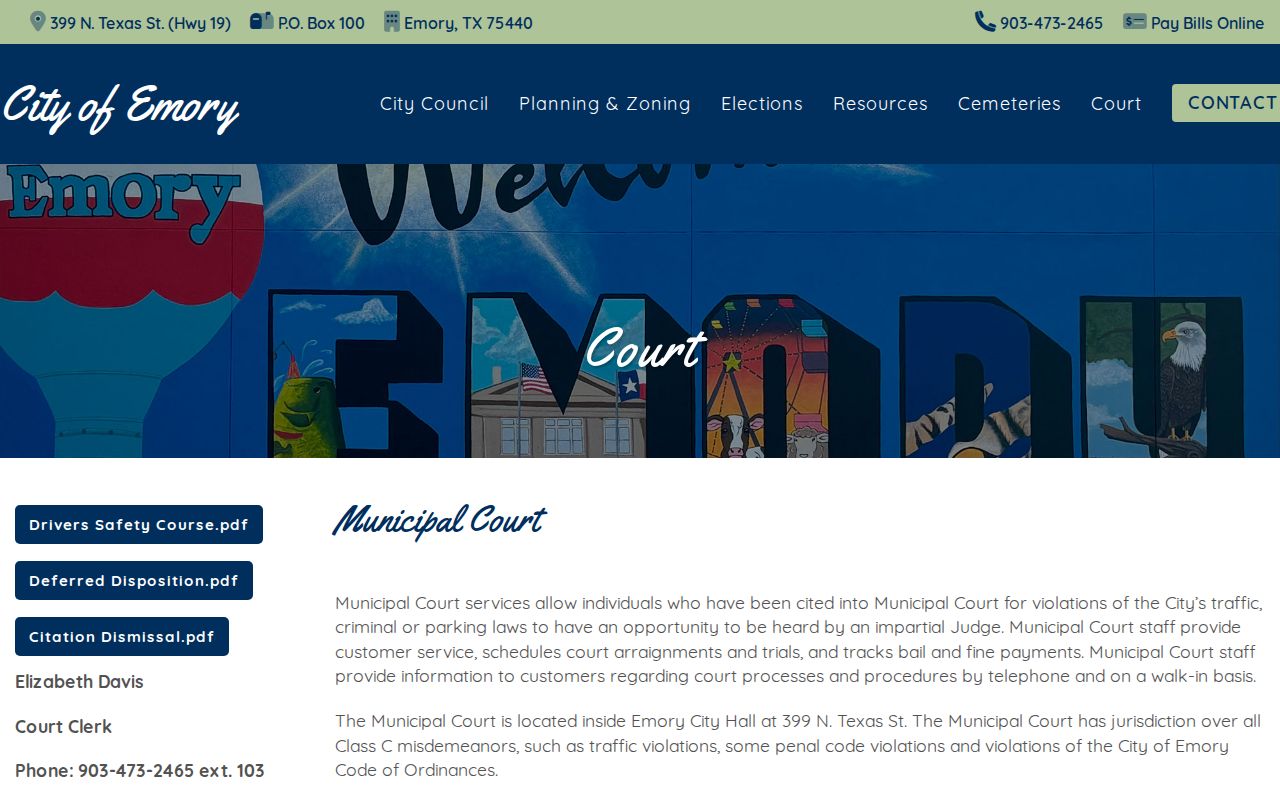
Emory access is clerk-and-form based. The pages do not prove a public terminal, a parking rule, or a search database exists.
Emory Record Verification Steps
Before you count on any Emory court record, line up the details. Compare the court name and citation number. Then match the listed person and event date across the citation, the clerk response, and anything you downloaded. Close names and stale notices can send you to the wrong file. Ask Elizabeth Davis to explain status text you do not recognize instead of guessing at an abbreviation. Keep the docket and the full case file straight, too. A docket only lists settings and procedural entries. The file may hold the complaint, plea, request, signed order, receipt, and final disposition.
Missing date? Make sure the docket search did not run through Emory Municipal Court instead of a county portal. Missing payment? Give the clerk the confirmation number. Do not treat it as proof that every city requirement was met. When you need the final result, request the signed judgment or a certified disposition. Each step anchors your search to the Emory clerk. It also lowers the odds that a partial web record gets mistaken for the whole file.
City Hall and the mailing box handle different tasks. Confirm where each paper must go. Ask whether the clerk must receive it before a response period starts. Keep copies of the citation, the form, and proof of delivery. If the clerk sets a new hearing, write down the date, time, place, and reason. Those notes beat an undated page grab. You can check them against the next official Emory notice.